
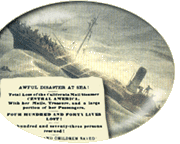

Helpless At Sea
How was the enormous treasure recovered at depths of 8000 feet?
The Washington Post’s September 14, 1989, article titled, “Storybook Treasure Found off South Carolina” stated, “Thompson and company . . . set out to do what never had been done before . . . not only to find the Central America but to excavate it with archaeological precision on the deep ocean floor using only undersea robotics. Nemo, their 12,000-pound, remotely operated exploration vehicle, has the capacity of recovering items as large as a 1,000 pound anchor or as small as a dime.”
What is the treasure worth?
Excluding the personal and nautical historic artifacts, the treasure trove of gold coins, ingots and miner’s dust should be placed in private collections for as much as $200 million.
What was gold worth in 1857?
During the California Gold Rush era of the 1850s, the United States Dollar was fixed to gold at the rate of $20.67 per pure troy ounce.
What would one of the assayer ingots actually buy in 1857?
In the California gold fields, a day’s wages was $5. Most of the ingots have a currency value of over $1,000, representing almost a year’s wages in the highly inflated California economy. The price of steerage accommodations on the SS Central America was $150. First-cabin accommodations were $300, which was quite a sum in those days.
What is the largest assayer ingot previously known to exist?
The most renowned numismatic reference guide, the Red Book, documents eight specimens that range in weight from 1.5 to 2.5 ounces. The Red Book also records the auction sale of a 2.5-ounce F. D. Kohler ingot (stamped with a $50 currency value) from the Norweb collection for $200,000 in 1989. The Smithsonian Institution received specimens from the famed Ford collection, the largest of which is about 2 ounces — a fraction of the Central America’s prized “Eureka” bar, which weighs 933 ounces. The Eureka bar is stamped with the 1857 currency value of $17,433.57.
Why didn’t large private assayer ingots survive?
Considering that private assayer coins survived in great quantity and are highly prized by collectors, it is amazing that very few specimens, all quite small, of the assayer ingots are still in existence. Although the assayer ingots were accepted in transactions, many of the private coins and ingots were refined and used to make new United States coinage, once the US mints were able to meet demand. Obviously, small private coins were preferred and hoarded, unlike the larger, inconsistent forms of money, such as ingots.
Shouldn’t the treasure be in a museum?
Many American’s feel that the entire treasure should be in a museum. They are correct that each piece is so rare and historically important that it warrants that level of appreciation and conservation. Fortunately, many investors and collectors do consider giving their family heirlooms to museums to be preserved for posterity
How were the efforts of Captain Herndon perceived?
Not only was the Herndon Monument erected in 1860 at the United States Naval Academy in Annapolis, but as Frank Leslie’s Illustrated Newspaper wrote in 1857, “There cannot be a doubt about the fact that the name of Captain Herndon will ever be held in grateful remembrance among all the heroes who have achieved triumphs upon the sea.”
Where can I find a DVD copy of the History Channel program "Ship of Gold?"
The History Channel has sold DVD copies of the program “Ship of Gold” online. Also, Monaco Financial, an Authorized Ingot Dealer, makes the video available to those who are interested. You may call 888-900-9948 for details.
How much did Warner Brothers pay for the movie rights to "Ship of Gold?"
The highly regarded rare coin periodical, The Numismatist, reported that a sum of $800,000 was paid by Warner Brothers to acquire the movie rights to the best seller, “Ship of Gold.”
How can I acquire a piece of this historic treasure?
There is a rare and important opportunity to acquire artifacts from this historic treasure at the moment. Consider calling an Authorized Ingot Dealer for details. You may call Monaco Financial, the primary ingot dealer, toll free at 888-900-9948.